ar in education elephant feedback canyongriss offers teachers practical tools for active learning. The technology places virtual objects in real rooms. It lets students interact with content in real time. Teachers track responses and give targeted comments. Schools report higher attention and faster skill gains. This article explains why AR helps learning and how Elephant Feedback and CanyonGriss fit into lessons.
Key Takeaways
- AR in education enhances learning by placing virtual objects in real spaces, helping students interact with content and understand abstract concepts better.
- Elephant Feedback and CanyonGriss work together to provide teachers with tools for real-time feedback, tracking student progress, and facilitating peer collaboration.
- The system’s stepwise visual layers reduce cognitive load, enabling students to focus on one task at a time and allowing teachers to identify misunderstandings early.
- Immediate feedback through Elephant Feedback motivates students by encouraging a growth mindset where mistakes are seen as learning opportunities.
- Teachers save time with reusable AR scenes and feedback templates, while the platforms automate scoring and data collection for efficient lesson planning and assessment.
- Data-driven insights from the platforms help educators tailor instruction, justify technology investments, and keep parents informed about student progress.
Why Augmented Reality Improves Learning Outcomes And Student Motivation
AR in education elephant feedback canyongriss appears in classrooms as two linked solutions. AR overlays content on desks and walls. Students move and point. They touch and speak. The interaction makes abstract ideas concrete. It increases recall and supports skill practice. Research shows visual and kinesthetic input boosts memory. Teachers observe more on-task behavior during AR sessions.
AR in education elephant feedback canyongriss reduces cognitive load for complex topics. The tool breaks steps into visual layers. Students see one layer at a time. They act on each layer. This stepwise view helps students focus on the immediate task. It also helps teachers spot misunderstandings early. Teachers pause the AR scene to correct errors. They repeat steps for struggling students.
AR in education elephant feedback canyongriss supports motivation through immediate feedback. The system gives quick prompts when a student succeeds or slips. Students get praise and correction in the app. They then retry. This loop of try, receive feedback, and try again increases mastery. The approach fits growth mindset teaching. Students treat mistakes as data, not failure.
AR in education elephant feedback canyongriss also supports group work. Students gather around a shared view. They point and assign roles. One student might manipulate a model. Another student might record observations. The teacher circulates and guides. This format encourages dialogue and peer teaching. Peer teaching reinforces content and builds social skills.
AR in education elephant feedback canyongriss integrates assessment data. The system logs actions, errors, and time on task. Teachers use dashboards to see patterns. They plan next lessons from real use data. Administrators use aggregated reports to justify tech budgets. Parents receive clear snapshots of progress.
Elephant Feedback And CanyonGriss: Practical Integration For Teachers
Elephant Feedback acts as the in-class feedback engine. CanyonGriss provides the AR scenes and content library. Together they let teachers build lessons that include live feedback and tracked performance. The platforms sync student accounts and keep records. Teachers import standards and map tasks to goals.
A teacher sets up a lesson in minutes. They pick an AR scene in CanyonGriss. They add checkpoints and prompts. They enable Elephant Feedback to record student voice notes and numeric scores. Students launch the scene on tablets or phones. The scene anchors to the table and the lesson begins.
Elephant Feedback captures peer comments and teacher notes. The app timestamps each entry. It links entries to the AR object the student used. Teachers filter feedback by student, skill, or time. They export summaries for meetings or report cards. The summaries show growth and remaining targets.
CanyonGriss supplies editable models for science, history, and math. Teachers modify labels and hide or reveal parts. They create tiers of difficulty and assign them to student groups. The platform supports offline use. Schools with limited connectivity can preload scenes before class.
Elephant Feedback supports rubrics and quick polls. Students tap rubric levels during a task. The app logs the choice and shows class distributions. Teachers use the distributions to start short reflective talks. These talks help students compare approaches and revise work.
CanyonGriss and Elephant Feedback comply with common privacy standards. They store data in encrypted form. Schools control access and retention. District IT teams can host the services on local servers if they prefer.
Teachers report lower prep time after initial setup. They reuse scenes and feedback templates. They share templates within departments. The shared library speeds adoption and creates consistency across grades.
Elephant Feedback and CanyonGriss reduce grading load for routine tasks. The apps auto-score objective items and collect short student reflections. Teachers review highlighted errors and add targeted comments. They spend more time on planning higher-order tasks and less time on basic checks.
Step-By-Step Lesson Example — AR Peer Review Using Elephant Feedback
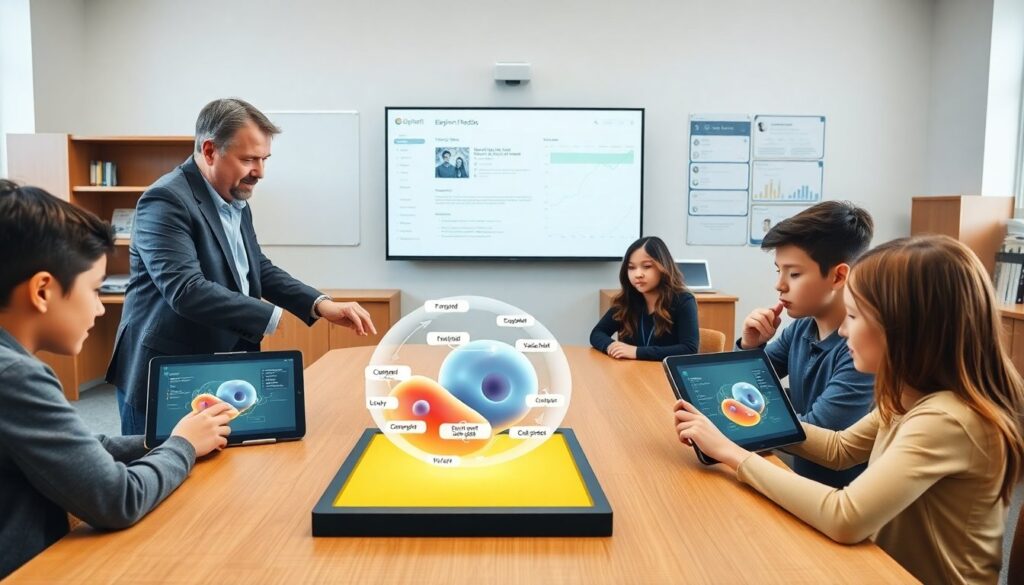
The teacher prepares a CanyonGriss AR scene of a cell model. They set three review checkpoints: structure ID, function match, and improvement suggestion. The teacher assigns students to pairs and gives each pair a tablet.
Students open the scene and inspect the model. Student A labels parts while Student B observes. They switch roles at the second checkpoint. Each student records a 20-second voice note in Elephant Feedback for their partner. They answer two prompts: “What worked?” and “What to change?”
Elephant Feedback timestamps each note and links it to the checkpoint. The teacher reviews notes on a brief dashboard view. They listen to one sample note aloud. The class discusses common strengths and fixes for five minutes.
Students revise labels and functions in the AR scene. They resubmit a brief checklist in Elephant Feedback. The app scores the checklist automatically. The teacher scans the scores and flags two students for targeted follow-up.
The teacher assigns a short assignments task. Students create a static diagram from the AR model and attach a final voice reflection. Elephant Feedback collects reflections and sends a weekly summary to the teacher.
This sequence shows how AR in education elephant feedback canyongriss supports active practice, quick feedback, and efficient review. The flow keeps students engaged and helps teachers focus on higher-value instruction.