
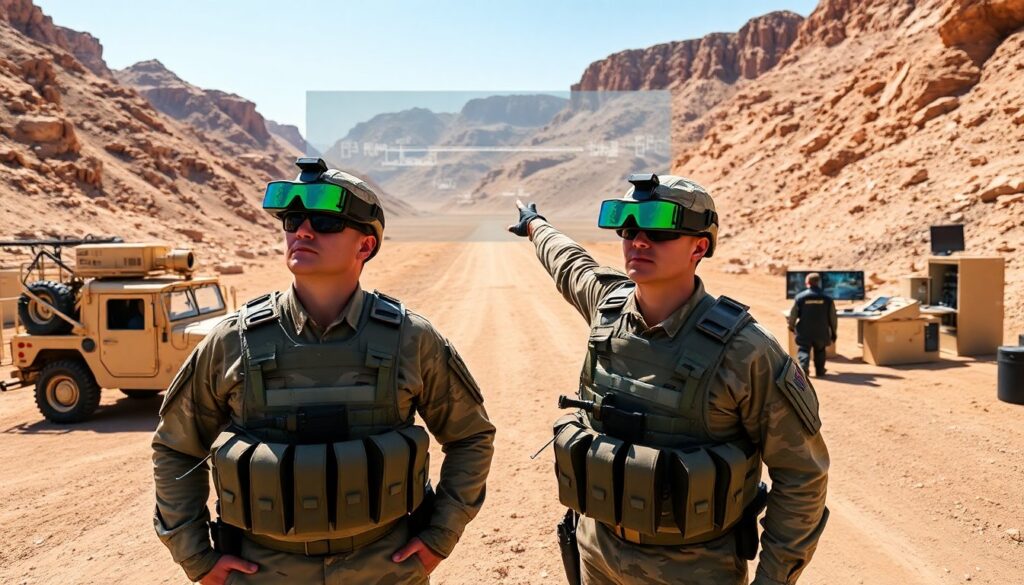
The article explains how ar military training lion canyongrss changed training at Lion Canyon. It states what the site does and why leaders adopt the system. It names measured results and safety rules. It sets expectations for practical uses and limits.
Key Takeaways
- The AR military training Lion CanyonRSS system enhances training by overlaying virtual forces onto real terrain, allowing low-cost, repeatable mission practice.
- Lion Canyon combines varied terrain with AR technology to support comprehensive live-fire and combined-arms drills for infantry, armor, and aviation units.
- Implementing AR involves integrated hardware, software, and rigorous safety procedures to create realistic scenarios and ensure operator wellbeing.
- The AR suite streamlines exercise setup, supports real-time scenario adjustments, and links to after-action reviews for faster learning and feedback.
- Measured results show improved skill acquisition, better teamwork, reduced equipment wear, and fewer safety incidents thanks to AR training at Lion Canyon.
- Future plans include overcoming current challenges like display weight and bandwidth limits with AI-assisted scenarios and enhanced sensors, securing AR as a core training tool.
Overview Of Lion Canyon Training Grounds And Their Strategic Role
Lion Canyon serves as a national training ground near varied terrain. Commanders use the site for live-fire drills and combined-arms practice. The site supports infantry, armor, and aviation units. The site hosts permanent ranges and modular lanes for urban, mountain, and desert drills. Leadership added ar military training lion canyongrss tools to expand scenario variety. The tools let instructors overlay virtual forces on real terrain. Units can repeat missions with low cost. The range staff manage scheduling, safety, and maintenance. The site links to training centers for doctrine updates.
What Augmented Reality Military Training Is And Why It Matters Today
Augmented reality places digital objects in a user’s real view. Commanders use AR to add enemies, hazards, and effects during live exercises. AR shortens the time to set up complex scenarios. AR helps units train for threats they cannot replicate safely. The term ar military training lion canyongrss refers to the specific AR suite used at Lion Canyon. The suite includes tactical overlays, friend-or-foe markers, and mission recording. Trainers can change parameters in real time. Units practice decision making under stress. Leaders value AR for cost control and repeatability.
How AR Is Implemented At Lion Canyon: Systems, Scenarios, And Safety
Lion Canyon implements AR in three layers: hardware, software, and procedures. The staff integrate head-mounted displays, vehicle-mounted projectors, and networked radios. The staff run the ar military training lion canyongrss suite from a central control station. Instructors script scenarios and inject variables for realism. The staff monitor system health and operator status. The site enforces safety buffers and no-go zones. The range links AR logging to after-action review systems. These links speed feedback and learning.
Technology Stack Powering AR Exercises
The technology stack uses sensors, edge servers, and radios. Operators use GPS, inertial units, and visual trackers. The stack runs simulation engines and a fused common operating picture. The stack supports low latency and encrypted links. The ar military training lion canyongrss package uses modular APIs for new content. The stack logs location and events for replay. The stack scales from squad to brigade level. The team updates software with automated patches.
Measured Outcomes, Key Challenges, And The Road Ahead
Evaluations show faster skill acquisition and lower exercise costs. Units trained with ar military training lion canyongrss report better target recognition and teamwork. Instructors note lower wear on materiel and fewer safety incidents. Challenges include bandwidth limits, display weight, and human factors. Planners must manage data overload and training fidelity. The site plans to add AI-assisted scenario generation and improved night sensors. Leadership budgets for iterative upgrades. The team expects AR to remain a central tool for practical, repeatable training.