
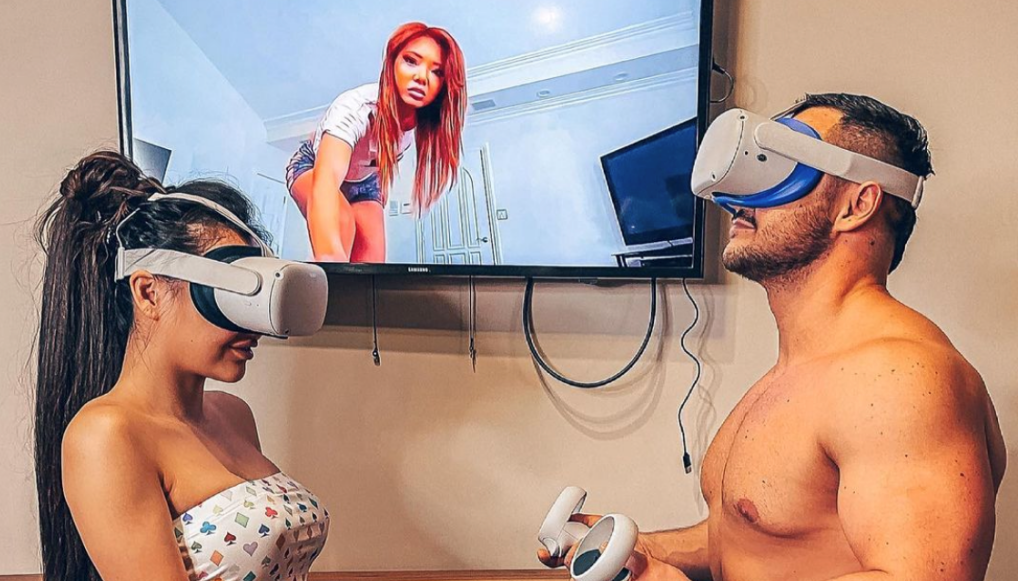
Virtual reality did not change adult entertainment by adding something spectacular. What it changed first was the position of the viewer. With traditional formats, the experience always stays in front of you. You sit back, you watch, and the scene unfolds on a screen that never truly reacts to your presence.
With VR, that distance begins to disappear.
When a virtual reality experience starts, you are no longer looking at a frame. You are placed inside a space. The camera is no longer something you observe — it becomes your point of view. Movements feel closer, not because they are exaggerated, but because depth is now part of the experience. The environment feels occupied instead of displayed.
That shift alone changes how the experience is perceived.
The Difference Between Watching and Being There
For years, adult content relied on observation. Even live formats kept the same structure. On a traditional cam girl platform, you enter a room where something is already happening, but the room does not depend on you. You can leave, return, or remain silent, and the environment continues unchanged.
Virtual reality breaks that logic.
In VR, the experience feels built around a single presence. When you move your head, the space responds. When you look away, the moment shifts slightly. Nothing is dramatic, but everything feels connected to where you are. This makes the experience feel less like content and more like a place you are temporarily inside.
That sensation is subtle, but it changes how long people remain engaged.
Why Immersion Feels Stronger in VR
Immersion in virtual reality does not come from intensity. It comes from continuity. There are fewer abrupt transitions. Less cutting from one angle to another. Less sense of scenes being assembled from separate pieces.
Instead, moments unfold naturally.
Pauses are not rushed. The environment feels stable instead of constantly trying to impress. This allows the viewer to settle into the experience rather than chase stimulation. Time feels different because attention is not being pulled in multiple directions at once.
This is one reason VR sessions often feel shorter than they actually are.
How Interaction Becomes More Personal
Interaction in VR is not about buttons or explicit choices. It happens through presence. Where you look, how close you feel, how long your attention rests on a moment. These small details influence how the experience unfolds.
This is especially noticeable with VR cam girls. The interaction feels directed rather than broadcasted. Instead of performing for a room full of viewers, the experience aligns with a single point of view. Movements feel intentional. Reactions appear calmer, slower, and more personal.
It does not feel like a performance.
It feels like shared space.
Why VR Does Not Feel Like a Performance
One thing that stands out in virtual reality experiences is the absence of constant pressure. In traditional formats, something always has to be happening. Movement, sound, action. In VR, stillness becomes acceptable.
The environment can exist without constant motion.
This creates a different rhythm. The experience does not rush toward escalation. It allows moments to develop at their own pace. That slower tempo keeps attention longer because it aligns more closely with how focus naturally works.
When the Technology Stops Being the Focus
After a while, the headset fades from awareness. The interface disappears into the background. The viewer stops thinking about resolution, angles, or technical details. What remains is the environment and the feeling of being inside it.
This is where virtual reality becomes effective.
When the technology disappears, immersion takes over. The experience no longer feels mediated. It simply feels present.
Virtual Reality as an Addition, Not a Replacement
Virtual reality is not replacing traditional formats. Standard videos, live streams, and classic platforms continue to exist because they serve different habits. VR adds something else. It offers a way to experience adult content that feels spatial rather than purely visual.
It does not compete by offering more scenes.
It competes by changing how scenes are felt.
Why More Users Are Turning to VR
The growth of virtual reality experiences is not driven by hype. It is driven by how naturally the format supports immersion. People are not looking for louder or faster content. They are looking for experiences that feel closer and more contained.
Virtual reality provides that by turning watching into occupying.
That is the benefit VR brings.
Not intensity.
Not novelty.
But presence.